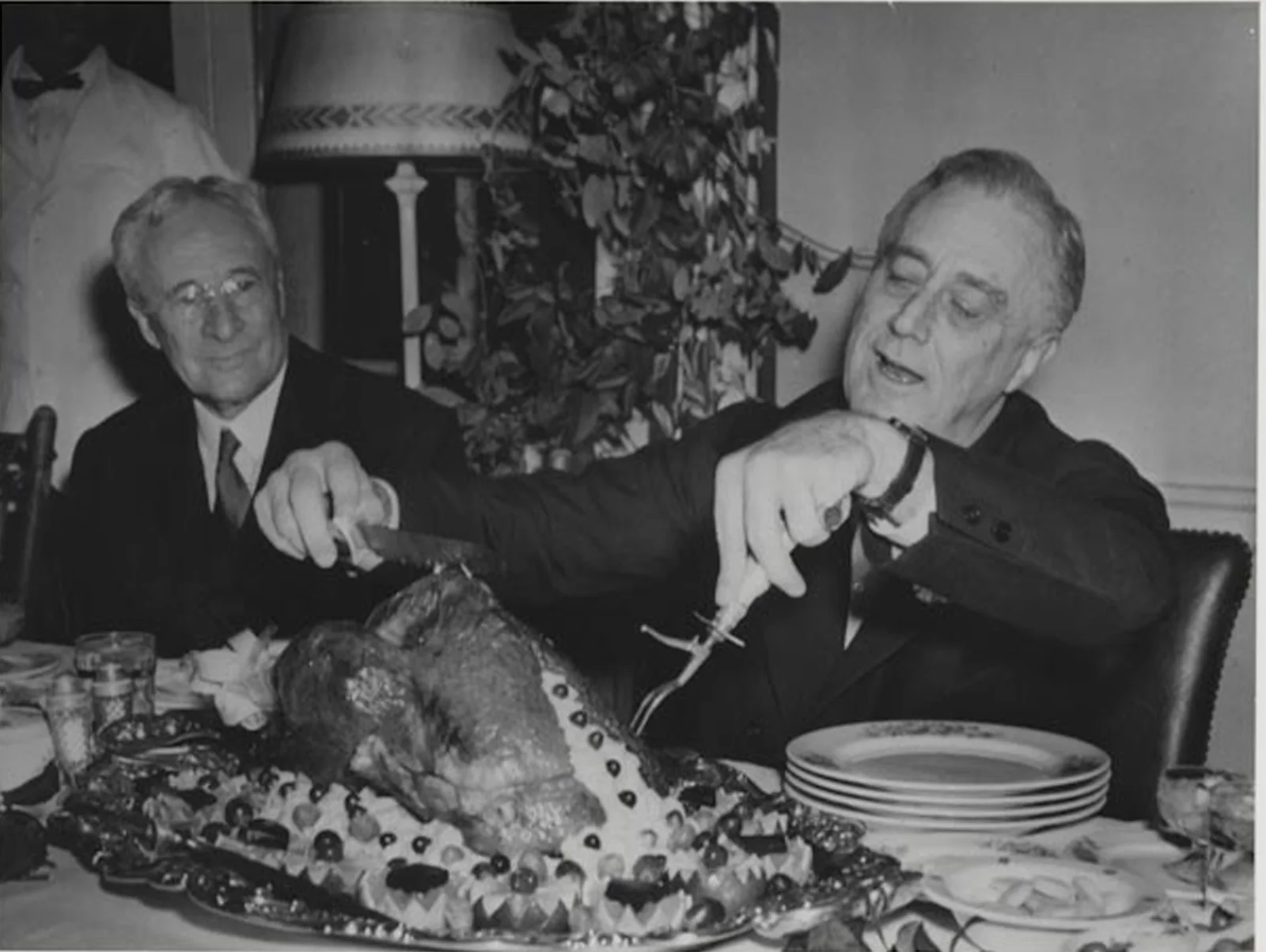
Photo from the Franklin D. Roosevelt Library, National Archives, via Wikimedia Commons (public domain). Border trimmed.
Thanksgiving on November 26th: The Date That Keeps Coming Back
Summary
- Thanksgiving 2026 falls on November 26th, the same date as the first Thanksgiving proclaimed by a president, George Washington's in 1789, as well as Abraham Lincoln's in 1863, and the first set by federal law in 1942.
- The holiday had no fixed date until Lincoln, urged by the magazine editor Sarah Josepha Hale, set the last Thursday of November in 1863, and President Franklin D. Roosevelt split the country in 1939 by moving it a week earlier to lengthen the Christmas shopping season.
- Congress settled the matter in 1941 with a law naming the fourth Thursday of November, which leaves between 27 and 33 days before Christmas, and 29 this year.
Thanksgiving falls on November 26th this year, and the holiday has been here before. The first Thanksgiving proclaimed by an American president was held on Thursday, November 26, 1789. The one that began the yearly tradition was held on Thursday, November 26, 1863. And the first Thanksgiving fixed by federal law, rather than by a president's choice, was held on Thursday, November 26, 1942.
None of that was planned. The holiday that now feels like the most settled day on the American calendar spent about 150 years without a permanent date, and the story of how it got one involves a new Constitution, a magazine editor who would not give up, a civil war, and an argument over Christmas shopping that split the country in two.
It began with a request from Congress. On September 28, 1789, just before leaving for recess, the first federal Congress asked President George Washington to recommend a day of public thanksgiving. Washington issued his proclamation five days later, on October 3rd, and assigned "Thursday the 26th day of November next." The thanks he had in mind were not for a harvest. His proclamation gave thanks for the end of the Revolutionary War and for the peaceful way the country had just set up its new government under the Constitution.
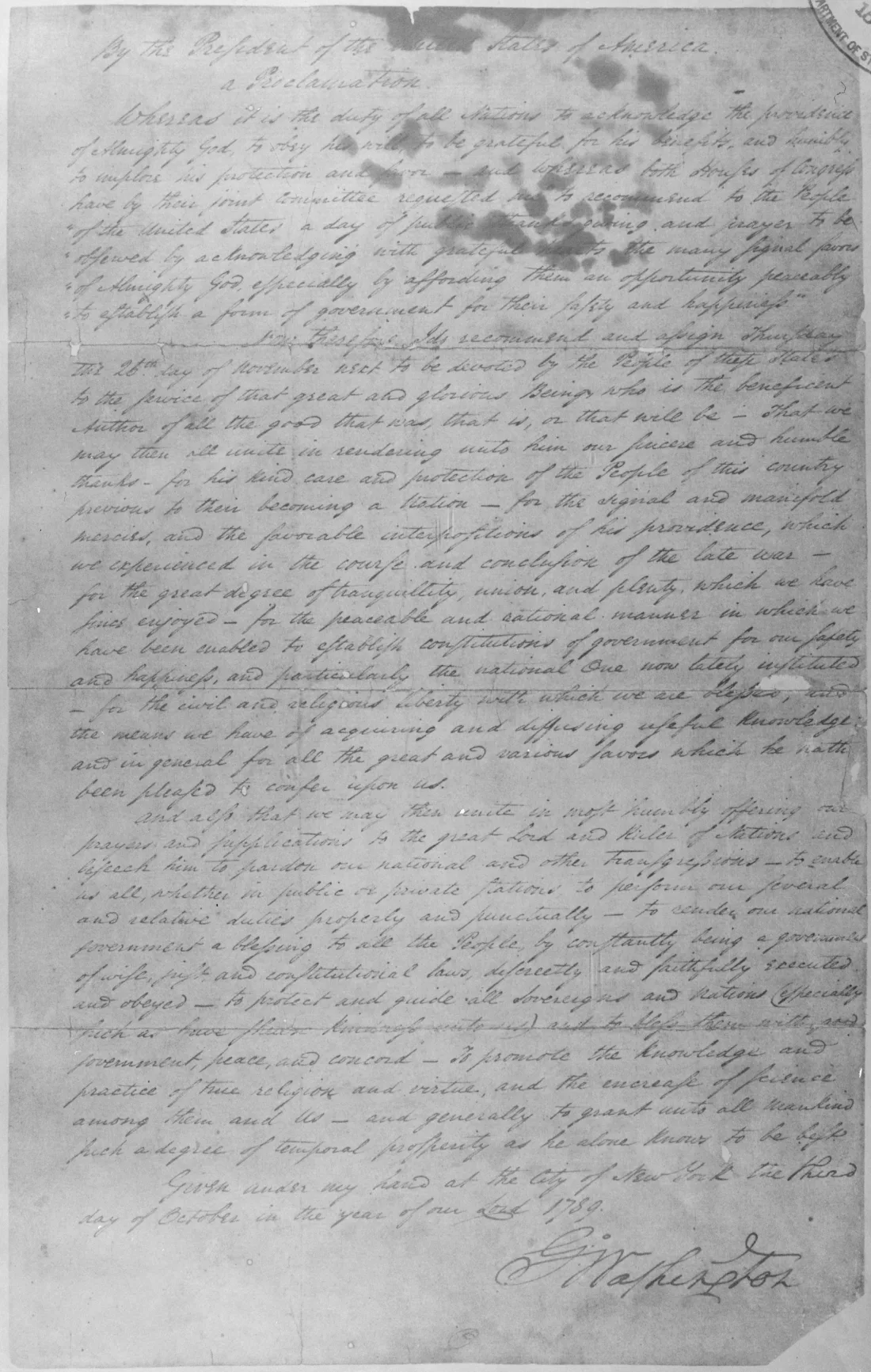
National Archives, via Wikimedia Commons (public domain).
It did not become a yearly event, and for decades it stayed that way. The presidents John Adams and James Madison proclaimed days of thanksgiving of their own, in whatever month suited the moment, while Thomas Jefferson thought the religious overtones were out of place for a president and issued none. After 1815 the proclamations stopped altogether. Thanksgiving survived as a regional custom, strongest in New England, with each state's governor choosing the day.
The person who changed that was Sarah Josepha Hale, the editor of Godey's Lady's Book, a magazine with a circulation of more than 150,000 by the Civil War, and the writer credited with the nursery rhyme "Mary Had a Little Lamb." Hale had described a New England Thanksgiving in her 1827 novel Northwood, and from her editor's desk she spent years urging governors, senators, and presidents to make the day a national one. By the 1850s many states had a Thanksgiving on the books, but they still did not agree on a date.
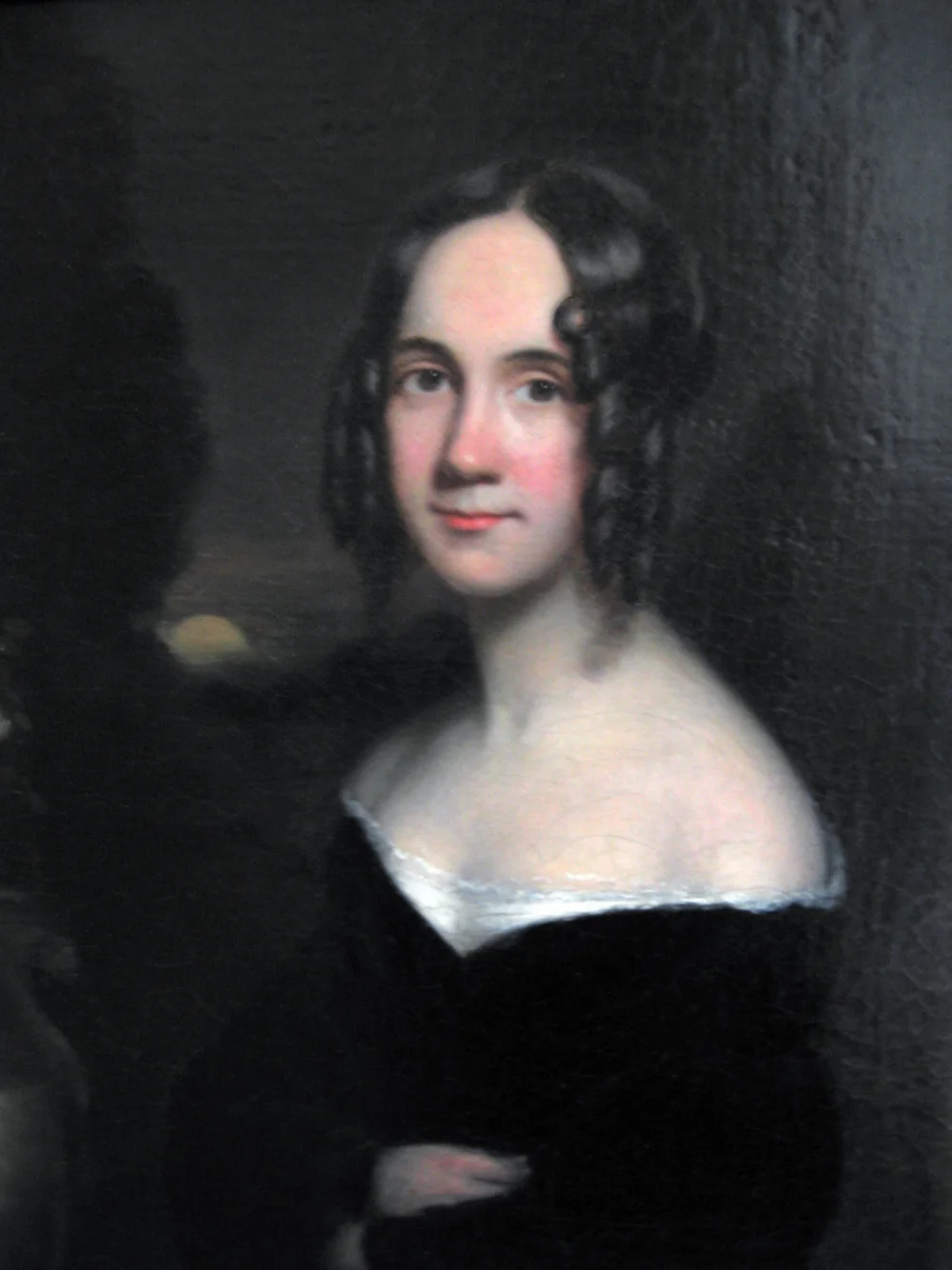
Via Wikimedia Commons (public domain).
On September 28, 1863, in the middle of the Civil War, Hale wrote to President Abraham Lincoln asking him to make Thanksgiving a "National and fixed Union Festival." This time it worked, and quickly. On October 3rd, Lincoln issued a proclamation, written by his secretary of state, William Seward, that set apart "the last Thursday of November next." By coincidence, Hale's letter and Lincoln's answer fell on the same two calendar dates, September 28th and October 3rd, as Congress's request and Washington's answer 74 years earlier. The last Thursday of November 1863 was the 26th.
Presidents after Lincoln proclaimed the holiday every year, nearly always for the last Thursday of November, and the custom held for 75 years. Then came 1939. November had five Thursdays that year, which pushed Thanksgiving to the 30th and left what one White House memo counted as only 20 shopping days before Christmas. Retailers, who had asked for an earlier date once before in 1933 and been turned down, asked again. On August 14th, at a press conference on Campobello Island, his family's summer retreat in Canada, President Franklin D. Roosevelt announced that he would move the holiday to November 23rd. "I am going to step it up a whole week," he said.
The country did not take it quietly. College football coaches had already scheduled their Thanksgiving games. Calendar makers had already printed several million calendars for 1940. The selectmen of Plymouth, Massachusetts, the town most associated with the holiday, wired the president the next day. The president's proclamation did not bind the states, so each governor had to choose, and they divided almost evenly. By one count, 22 states celebrated on the 23rd, 23 kept the 30th, and three, Texas, Colorado, and Mississippi, observed both. The earlier holiday picked up a nickname, "Franksgiving."
The experiment ran for three years, and the evidence that the earlier date helped stores sell more was thin. A retail trade group found that business was better where the earlier date was used. A survey that New York's mayor, Fiorello La Guardia, sent to Roosevelt in May 1941 found the opposite mood among the city's stores, with 76 in favor of the early date, 94 against, and 33 with no opinion. On May 20, 1941, Roosevelt told reporters that the experiment "did not work" and that Thanksgiving would go back to the last Thursday.
Congress decided to take the question out of presidents' hands for good. The House passed a resolution on October 6, 1941, making the last Thursday of November the legal holiday. The Senate changed one word, "last" to "fourth," a compromise that keeps Thanksgiving from landing as late as the 29th or 30th in years when November has five Thursdays. In those years the law gives the earlier date Roosevelt had chosen in 1939, so Congress kept part of his idea even though he had said it did not work. As Senator John Danaher of Connecticut put it, the point was "simply to have a fixed date so that everyone will know from now on." The Senate agreed two days after the attack on Pearl Harbor, and Roosevelt signed the law on December 26, 1941. The first Thanksgiving under it came the following year, on November 26th.
Under that law the holiday can fall on any date from November 22nd to November 28th. I counted every Thanksgiving from 1942 through this one, 85 in all, and the 26th has come up 13 times, once more than any of the other six dates. After this year it will not return until 2037.
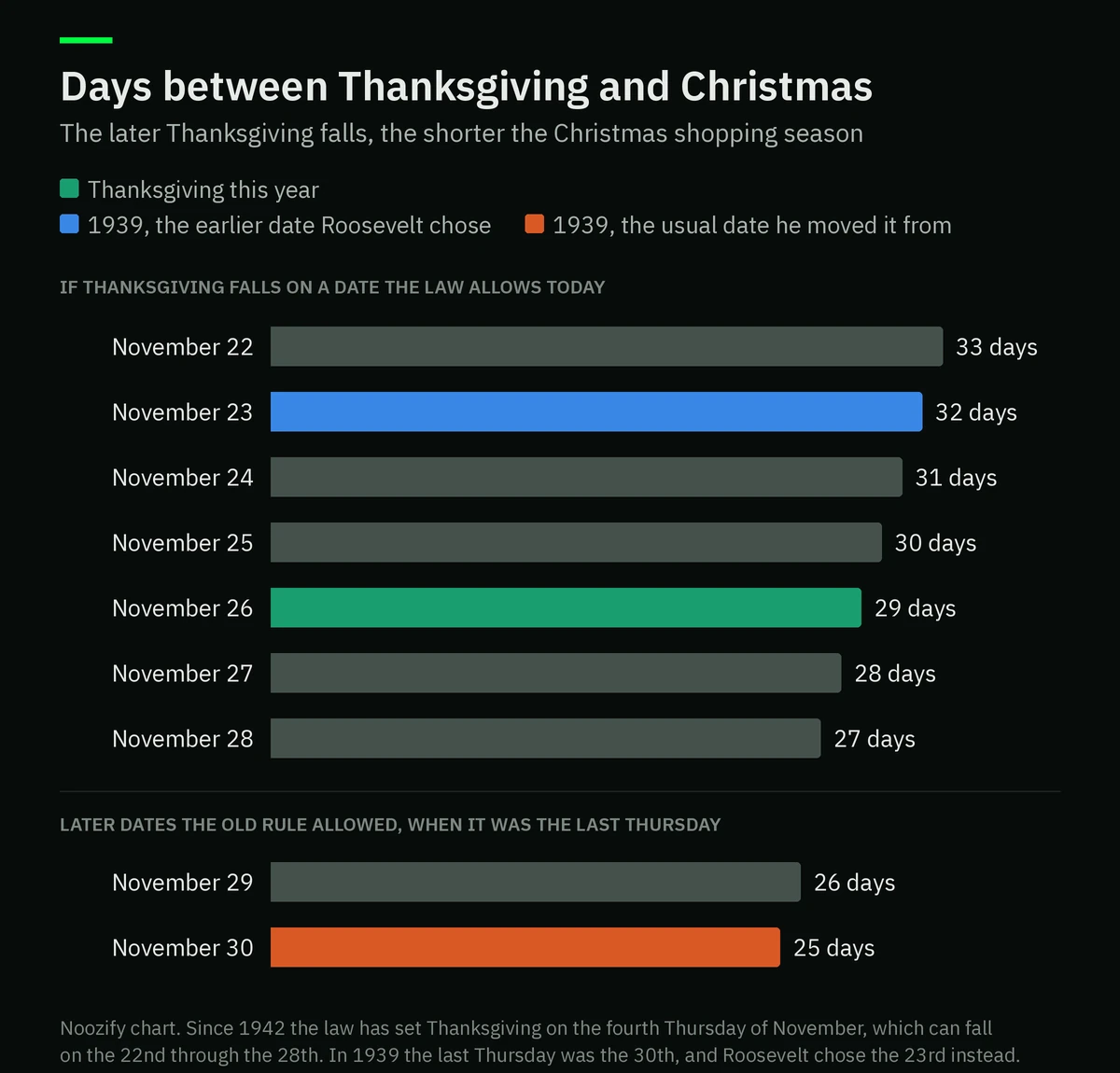
Noozify chart from calendar dates.
The retailers' old worry has not gone away, either. A Thanksgiving on the 26th leaves 29 days until Christmas, toward the short end of a range that runs from 27 days to 33. That is four days more than shoppers would have had in 1939 under the old rule, and three fewer than Roosevelt gave them. The shortest season the law allows, 27 days, comes next in 2030.
So the date on this year's calendar is more than a quirk of where the Thursdays fall. It is the day Washington picked in 1789, the day Lincoln's proclamation landed on in 1863, and the day the law finally took hold in 1942. It took a century and a half, an editor's stubbornness, and a fight over shopping days to pin the holiday down, and on Thursday it will land once again on the date Washington chose.