Photo by rc.xyz NFT gallery on Unsplash. Cropped to 16:9.
The Case of the Missing Memory: Why Game Consoles Keep Getting Pricier
Summary
- Every current game console costs more in the United States than it did at launch, led by the PlayStation 5 Digital Edition, up 50 percent to $599.99, and the Xbox Series S, up about two thirds to $499.99.
- The main cause is memory chips, which AI data centers are buying faster than factories can make them, and which also raise the price of gaming PCs, graphics cards, and Valve's Steam Deck.
- Forecasts show memory prices still rising through 2027, with substantial new factory capacity not expected until 2028.
Grand Theft Auto VI reached players on November 19th, and the timing could hardly have been worse for those seeking to buy the hardware required to run it. The PlayStation 5 Digital Edition, which debuted at $399 in 2020, now carries a recommended price of $599.99. A machine that just turned six years old costs $200 more than it did on opening day, an increase of 50 percent, and that ought to strike anyone as peculiar.
Peculiar, because history trained us to expect the opposite. Console generations have traditionally slid downward along a gentle curve, as manufacturing economies matured and the maker trimmed prices to coax late adopters aboard; the PlayStation 2 opened at $299 in 2000 and later sold for well under $200. So the question worth chasing this holiday season is a simple one, namely what could make an aging appliance appreciate in value, and the first few suspects turn out to be innocent.
Sony's latest adjustment took effect on April 2nd, when the PS5 rose to $649.99, the Digital Edition to $599.99, and the PS5 Pro to $899.99. Measured against launch prices, those are increases of roughly 30 percent for the disc model, 50 percent for the Digital Edition, and 29 percent for the Pro, which began at $699.99 and made a stop at $749.99 along the way. Sony's stated reason was strikingly vague, citing "continued pressures in the global economic landscape," as Isabelle Tomatis, a vice president of global marketing at Sony Interactive Entertainment, put it, though Reuters framed the move against a surge in memory chip costs.
Microsoft was blunter, and its arithmetic is harder to stomach. Since August 1st the Series S has cost $499.99 and the Series X $799.99, which means the entry model, born at $299, has risen by about two thirds and now costs what the flagship did at launch. Team Xbox told customers that "console storage and memory prices have increased by more than 2.5x," and reminded them that consoles are customarily sold for less than they cost to build.
Nintendo's increase is the gentlest of the lot, rising from $449.99 to $499.99 on September 1st, or about 11 percent. Shuntaro Furukawa, Nintendo's president, named the AI-driven memory shortage as the largest factor and said the higher price still would not cover all of the added costs, which Nintendo estimated near 100 billion yen, or roughly $600 million. He has since said the company is not considering additional changes to the price, a carefully worded statement that stops well short of a promise.
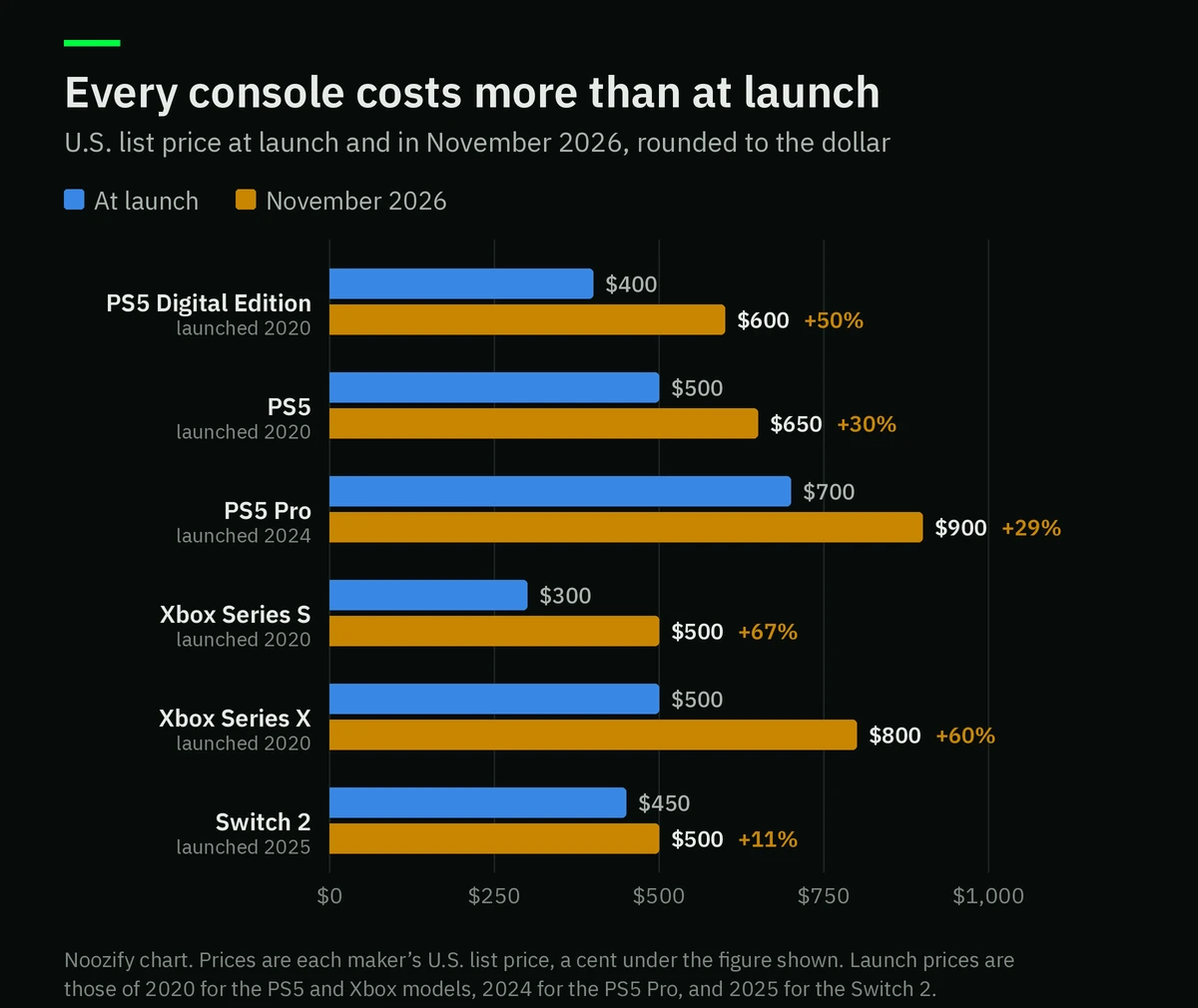
Noozify chart from the prices in the announcements and reports linked in this article.
Here the first real clue appears. According to TrendForce, a research firm that tracks the chip industry, memory accounts for roughly 21 to 23 percent of the Switch 2's price but about 35 percent for a PS5 or Xbox, which tracks the pattern of the price increases rather well. The more memory in the box, the larger the bill, and the culprit begins to look less like corporate appetite than like a single ingredient.
The other suspects fare poorly. Tariffs were the favored explanation last year, when an analyst warned they might force Nintendo to raise the Switch 2's price, yet this year's announcements name memory almost uniformly. Nor is slack demand forcing anyone's hand, since Circana, which tracks video game sales in the United States, reported that average Xbox Series prices rose 29 percent year over year in October while unit sales still climbed 10 percent.
Upstream, the memory market has been overrun by a customer with a very large checkbook. Esquire, citing the market-intelligence company Cleanview, counts 1,278 data centers this year against 361 in 2016, and the same piece reports that JP Morgan Global Research put the rise in memory prices at more than 400 percent over two years. Even the prices that big manufacturers negotiate with memory makers roughly doubled in the first quarter and then rose by more than half again in the second, according to TrendForce.
Not all of that checkbook is the customer's own money. Analysts have a name, circular financing, for deals in which a chipmaker invests in, or lends money to, the very companies that buy its chips, and they warn that such deals can make the demand for AI look larger than it really is. Nvidia's plan, announced last year, to invest up to $100 billion in OpenAI, the maker of ChatGPT and a major buyer of Nvidia chips, was the best-known example, until Jensen Huang, then Nvidia's chief executive, all but confirmed in March that the deal had fallen apart. Memory was swept into the same loop when OpenAI signed letters of intent with Samsung and SK hynix for roughly 40 percent of the world's output of DRAM, the type of memory inside consoles and PCs, without being legally bound to buy any of it.
The sheer appetite for memory is really only half the story. To make matters worse, the special memory that powers AI chips is far more demanding to make, using three to four times the factory capacity of ordinary memory, and TrendForce expects it to use about 23 percent of the world's memory factory capacity this year and about 30 percent in 2027, even though it will make up only about 13 percent of the memory those factories turn out. Every bit of capacity handed to the data center is taken away from the pool that a console maker, or a laptop maker, must buy from.
Graphics cards share the affliction. Nvidia's flagship RTX 5090 launched at $1,999, and in August its lowest price on Tom's Hardware's tracker stood at $4,381. Graphics cards carry memory chips of their own, and a 3-gigabyte chip of the newest kind reportedly costs triple the price of a 2-gigabyte one, a gap said to be holding Nvidia's next round of cards in limbo. The Wall Street Journal has since reported that Nvidia financed some of its own customers this year in part to keep graphics chip prices high, a claim that remains unproven.
Valve, the company behind the Steam game store, offers yet another case study with its handheld gaming PC, the Steam Deck. In May it raised the Steam Deck OLED from $549 to $789 for the 512-gigabyte model and from $649 to $949 for the 1-terabyte model, attributing the change to component costs. It then priced the Steam Machine, its console-style gaming PC, at $1,049 for a June 30th launch, when Notebookcheck estimated it would have cost about $750 in normal conditions. The research firm IDC projects that PC shipments will fall 11.3 percent this year.
Whether any of this eases soon is a less cheerful matter. TrendForce told a Seoul audience on November 18th that increases in the contract price of memory will narrow from 5 to 10 percent in the first quarter of 2027 to 0 to 5 percent by the second half, with no quarterly decline anywhere in its table. Kwak Noh-jung, the chief executive of the memory maker SK hynix, said in July that 2027 would be the worst year for supply in the industry's history. Microsoft, for its part, has said it expects storage and memory prices to double again by the fall of 2027.
And yet the pattern should eventually break, for a reason as old as the industry itself. Memory has historically swung between scarcity and glut, because shortages invite factories and factories, once built, tend to overshoot. TrendForce expects the big memory makers to release substantial new capacity in 2028, and it sees prices for flash memory, the kind used for storage, turning lower as early as the second quarter of 2027, so storage should be the first to relent.
That timing carries a final irony. Sony is considering delaying its next console to 2028 or even 2029, according to Bloomberg's reporting, which would land the PlayStation 6 just as memory prices begin to loosen, if they do. The aging console under the tree is not really a pricier machine; the ingredients are simply being bid for by a richer buyer. If you are shopping this holiday season, the forecasts offer little reason to expect a bargain before the next generation arrives.