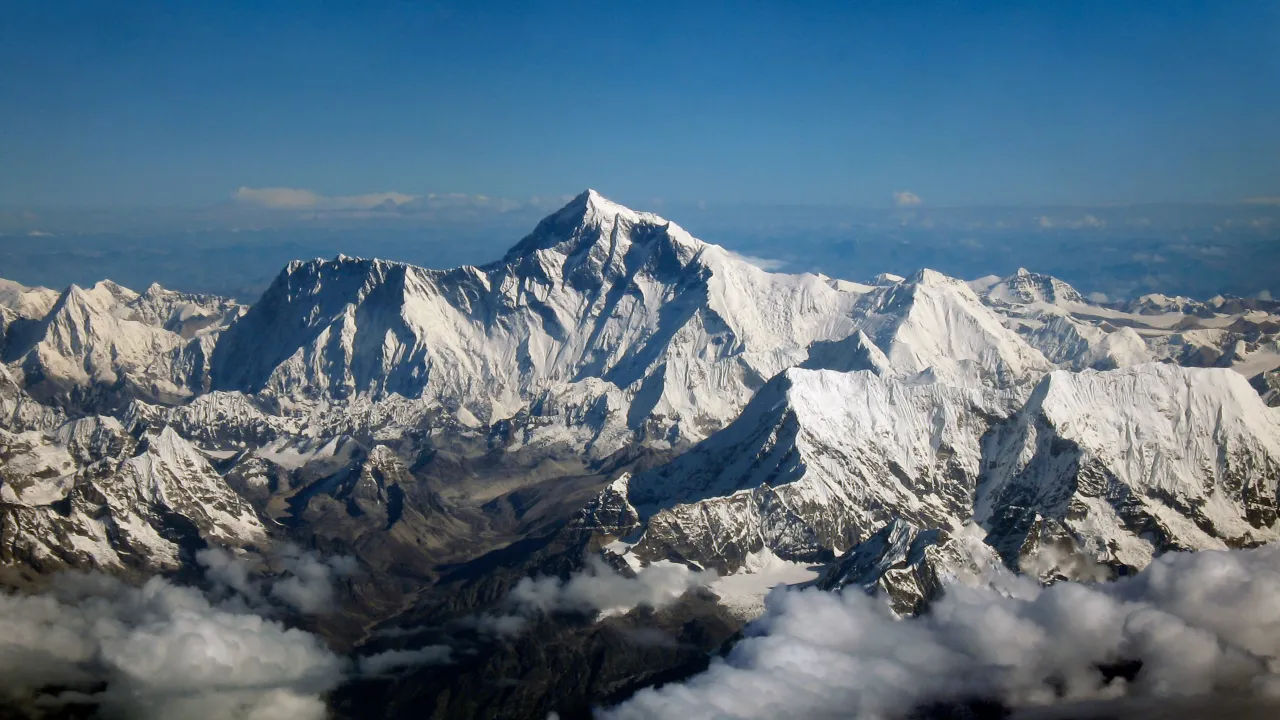
Photo by shrimpo1967, edited by Papa Lima Whiskey 2, via Wikimedia Commons (CC BY-SA 2.0). Cropped to 16:9.
Tenzing on Apple TV: The Man Behind the Summit Photograph
Summary
- Tenzing, now streaming on Apple TV, retells how Tenzing Norgay and Edmund Hillary together became the first people to reach the summit of Mount Everest, on May 29, 1953, and tells it from Tenzing's side.
- Genden Phuntsok stars as Tenzing, with Tom Hiddleston as Hillary and Willem Dafoe as the expedition leader, John Hunt, and the Himalayan photography is breathtaking.
- The film sometimes feels too polished, but Noozify gives it an A− overall, with an A for both acting and production.
At 11:30 on the morning of May 29, 1953, two men stood on the summit of Mount Everest for the first time. One of them, Edmund Hillary, a beekeeper from New Zealand, took a photograph of the other, Tenzing Norgay, holding his ice axe in the air. The picture went around the world, and so did Hillary's name. Tenzing, now streaming on Apple TV, is about the man in the photograph.
It is hard to think of better material for an adventure drama. Tenzing was born in 1914 and grew up poor on the edge of the Himalayas, ran away from home as a teenager, and settled in Darjeeling, India, where expeditions hired their porters. He first went to Everest in 1935, with a British expedition, and kept going back for nearly two decades. He returned with more British teams, and once with a Canadian-born adventurer who slipped into Tibet without permission. In 1952, a Swiss expedition took him to within about 800 feet of the top. By the time a British expedition arrived in 1953, he had been to the mountain six times and knew it better than anyone on the team that hired him. He was 39. What makes the story inspiring is less the summit than the years of being turned back from it and returning anyway.
The film exists because of an earlier one. Jennifer Peedom, its Australian director, made the 2015 documentary Sherpa, which followed an Everest season from the point of view of the Sherpas who carry the loads and fix the ropes. Through it she came to know Tenzing's family, and she found that much of his early life had never been recorded. She has said she was surprised that the story "hadn't been told already," and that she wanted to understand "the man behind that image and what his sacrifices were, and what was driving him up the mountain." With almost no photographs or film of his childhood and early climbs, a documentary could not do it. "It was really the story that dictated the form," she told TheWrap. The screenplay is by Luke Davies, who was nominated for an Oscar for Lion, from a story he and Peedom worked out together, and Tenzing's eldest son, Norbu Tenzing, is an executive producer.
Video: Tenzing — official trailer from Apple TV
The three leads are the best reason to watch. Genden Phuntsok, a Tibetan actor little known to Western audiences, plays Tenzing as a quiet man who simply will not stop. He is lovable without ever asking to be liked, and his persistence carries him through one personal setback after another, on the mountain and off it. By the end I was rooting for him the way you root for a friend.
Tom Hiddleston plays Hillary as a warm, approachable Kiwi, the lone New Zealander on a very English team and the one climber who treats Tenzing as an equal from the start. It would have been easy to shrink Hillary in order to enlarge Tenzing, and the film is wise not to. The friendship between them feels earned, and it helps that the two actors trekked for six days along the original route to base camp before filming began.
Willem Dafoe is Colonel John Hunt, the British Army officer who led the expedition, and he is ruthlessly practical. Hunt is a fastidious manager who plans every stage of the climb, and he chooses who goes up on what the plan requires. Dafoe has described the character as "a military man first, and maybe a mountain guy second," and that is how he plays him. Yet the man is human and sincere underneath, and Dafoe lets you see what each hard decision costs him.
The 1953 climb is the spine of the film, and it is broken up by flashbacks to Tenzing's boyhood, his earlier expeditions, and his marriage to his first wife, Dawa, who died young. Flashbacks can stall a film like this. Here they are well balanced against the main storyline, and they give it context and texture. Each one explains a little more about why this man, on this attempt, cannot turn around.
Then there is the mountain. Peedom filmed in Nepal, in Kathmandu and the Everest region, and at altitude on Aoraki (Mount Cook) in New Zealand, and the photography by Stefan Duscio is breathtaking. The film also takes the trouble to lay out the route, so that you always know where the climbers are and what stands between them and the top. It rises through the broken ice of the Khumbu Icefall, along the long valley above it, up the steep Lhotse Face to the windy saddle called the South Col, and along the final ridge. That clarity, more than any single image, gives everything a sense of scale. To Tenzing the mountain is Chomolungma, a goddess to be approached with permission, and the camera treats it that way.
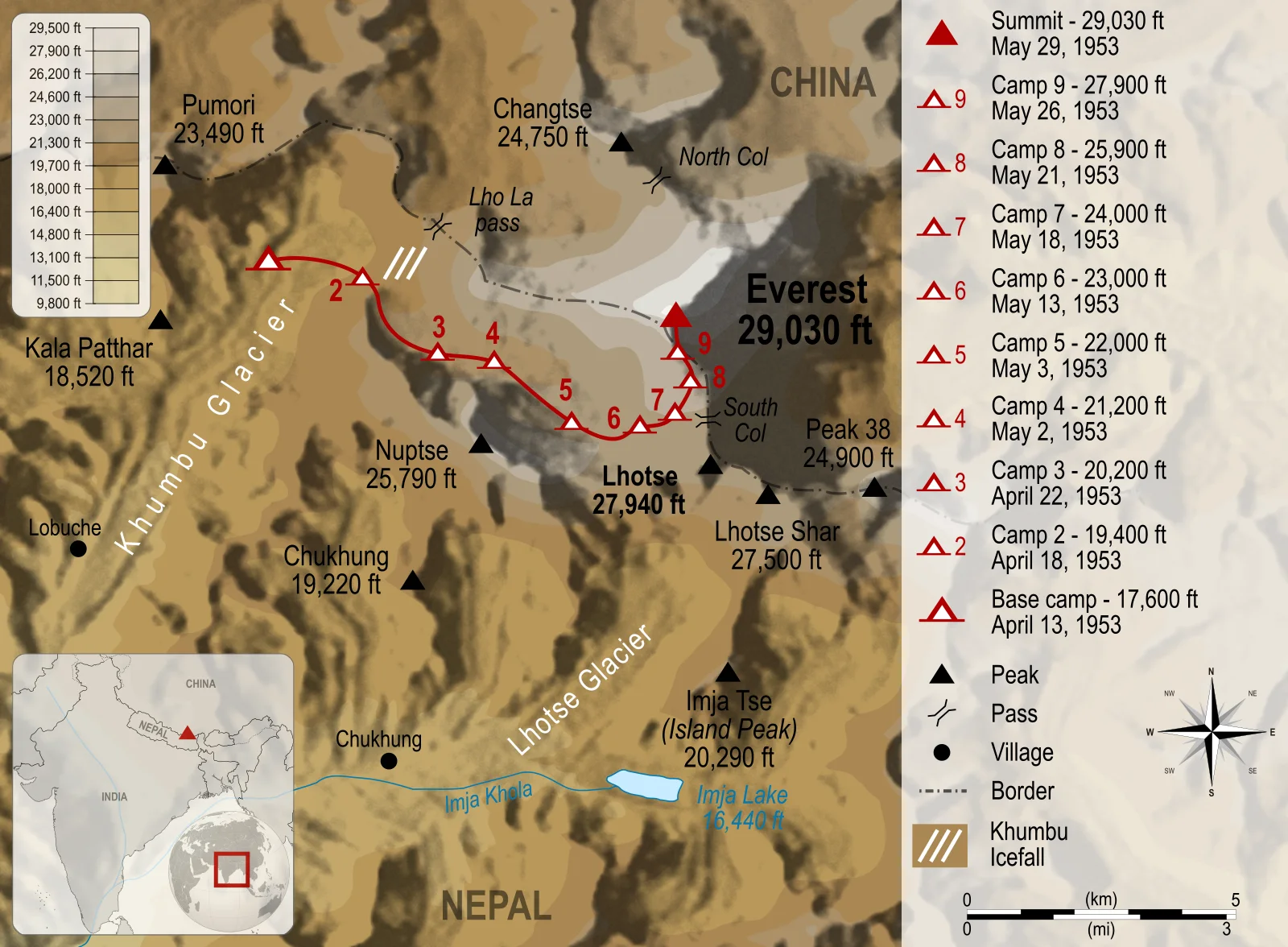
Map by Sémhur, with the route from a map by Lencer, via Wikimedia Commons (CC BY-SA 4.0). Noozify translated the labels from French and converted the heights from meters to feet; this version is shared under the same license.
My one reservation is that Tenzing sometimes feels too polished. The cold, the exhaustion, and the fear are all present, but they are tastefully lit and neatly resolved, and a story about men pushed to their limits could use a little more grit. A few more rough edges would have made the triumph hit harder.
It still hits. Tenzing is a handsome, moving, and generous film that gives a famous photograph back its subject, and it is well worth two hours of an evening.
Noozify's overall grade for Tenzing is an A−, the average of four report-card grades on an A-to-F scale.
| Subject | Grade | Comment |
|---|---|---|
| Acting | A | Genden Phuntsok is quietly magnetic as Tenzing, and Tom Hiddleston and Willem Dafoe give him warm and flinty company. |
| Directing | B+ | Jennifer Peedom keeps a clear line through the climb and balances the flashbacks well, though her touch can be too tidy. |
| Writing | B+ | Luke Davies's script gives all three men real dimension and makes the past serve the present. It could use more grit. |
| Production | A | Filmed in Nepal and New Zealand, it shows the Himalayas at full scale and makes the route up Everest easy to follow. |
| Overall | A− | The four grades average to about 3.7 on a 4-point scale. |